Canceled on January 15, 2010; Superseded by the MUTCD, 2009 Edition
 |
Memorandum |
| U.S.
Department of Transportation |
| Federal
Highway Administration |
 |
via Electronic Mail
| Subject: |
INFORMATION:
Traffic Control Strategies for Toll Plazas |
Date: |
October 12, 2006 |
| From: |
Jeffrey
F. Paniati /s/Jeffrey F. Paniati
Associate Administrator for Operations
Jeffrey A. Lindley /s/Jeffrey A. Lindley
Associate Administrator for Safety |
Reply
to
Attn of: |
HOTO-1
HSA-1 |
| To: |
Associate
Administrators
Chief Counsel
Directors of Field Services
Resource Center Director and Operations Managers
Division Administrators
Federal Lands Highway Division Engineers |
 |
Background
Our national transportation system is experiencing an increase in the use
of toll collection facilities. This trend will grow significantly as SAFETEA-LU
offers States and other qualifying transportation agencies more opportunities
to enact tolls as a means of financing various operating, construction, or
reconstruction projects.
One challenge for engineers, designers, planners, and other decision makers
in the transportation field is that there are few, if any, traffic control
standards for operating toll plazas in a consistent and uniform manner. Consistency
and uniformity of traffic control strategies are important safety factors
to consider because of the potential benefits they present for promoting
efficient traffic flow, improving driver familiarity, as well as creating
quicker recognition and response time.
The FHWA, in collaboration with the International Bridge, Tunnel and Turnpike
Association (IBTTA), recently completed a study of traffic control strategies
at toll plazas
and issued a report entitled, "State of the Practice and Recommendations
on Traffic
Control Strategies at Toll Plazas." This report is posted on
the Manual on Uniform Traffic Control Devices (MUTCD) Web site at https://mutcd.fhwa.dot.gov.
The recommendations in this policy memorandum are based on that report. We
believe that the findings and recommendations contained in the report will
be useful to agencies (1) seeking new solutions to improve safety and operations
of existing toll plazas; (2) contemplating replacement or modification of
an existing toll plaza; or (3) planning a new toll plaza.
Purpose
The purpose of this policy memorandum is to provide guidelines on certain
traffic control strategies and devices used at mainline toll plazas. The
recommendations discussed in this policy memorandum are intended to provide
a consistent strategy for guiding and controlling the movement of vehicles
through mainline toll plazas in an orderly manner so that safety is enhanced,
and better efficiency and economy of design is achieved.
Action
We strongly encourage the implementation of the recommendations prescribed
in this memorandum by all public and private agencies that operate toll plazas
particularly when addressing facility retrofits, reconstruction, or any new
construction. The
FHWA is considering proposing some of these provisions in the notice for proposed
rulemaking (NPRM) for the next edition of the MUTCD. This NPRM would
clearly identify the proposed standards, guidance, and options and would
provide the public an opportunity to review and comment.
Specific Guidance for Traffic Control Strategies and Devices
at Toll Plazas
- Advance Signing is necessary and recommended especially where
Electronic Toll Collection (ETC) and other mixed payment types are combined
at mainline toll plazas. Advance signs
should be placed at the 1-mile and 1/2-mile points before
a mainline toll plaza and may also be placed at the 2-mile point, if feasible.
(For toll plazas on entrance and exit ramps, advance signs should be provided
on the ramp if there is sufficient distance). The
advance signs should warn of the Toll Plaza Ahead
and, if appropriate, regulatory signs should identify which lanes to
use for each payment type and any vehicle restrictions. Toll rate information
should also be included on the advance signs or supplemental signs to give
motorists notice of the required payment at the toll booths.
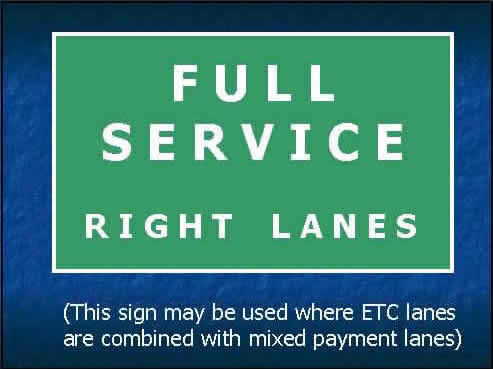
- Lane Assignment guidance is important to travelers when approaching
and navigating through the toll plaza. Providing clear and consistent
advance orientation information helps the traveler to make early decisions
on lane selection. There are 3 primary lane payment types: ETC,
Automatic Coin Machines (ACM)/exact change, and attended lanes for other
cash transactions. Lanes for each payment type should be grouped together.
Also, for mainline toll plazas all ETC dedicated lanes should be clustered
to the left in the toll plaza since the left lane is understood to be the
lane where motorists travel at higher speeds. In general, the lanes
with an attendant are considered the slower processing lanes and should
be located to the right in the plaza. The ACM lanes are considered faster
than attended lanes but slower than ETC lanes. They should be located
in the center between the attended and express lanes. (In some cases,
where needed to serve traffic entering from or exiting to ramps immediately
before or after the toll plaza, some lanes for specific payment types may
have to be provided separate from their main cluster).
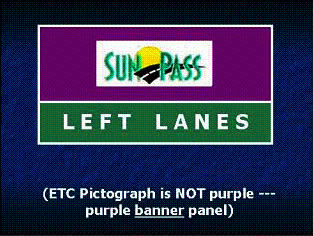
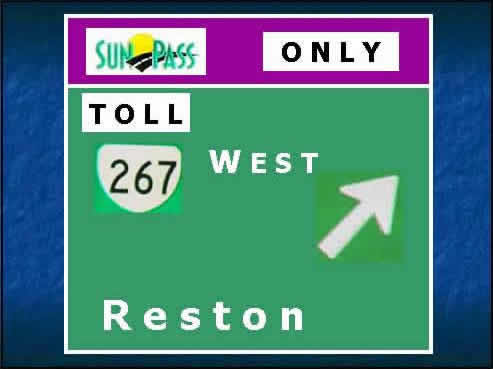
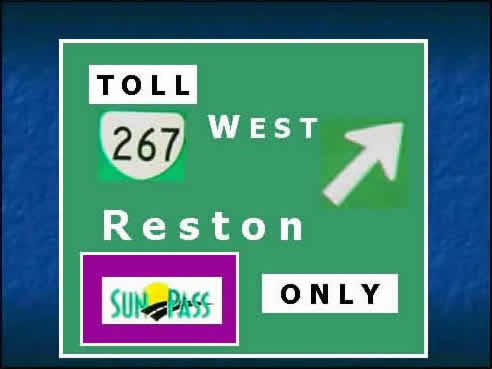
- Color of Toll Signs: The Federal Highway Administration
recommends that the background color for toll guide signs should be green.
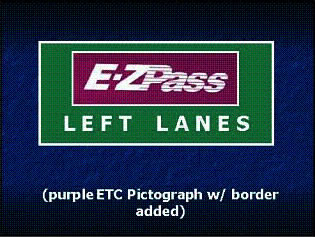
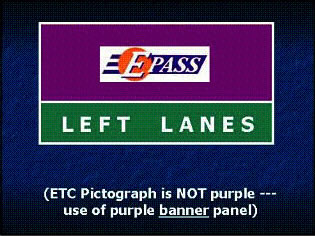
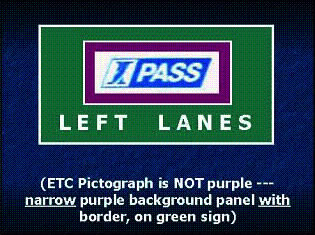
When the ETC pictograph is used, it should have a white underlay and should
be placed on a purple square panel with a wide white border that is then
incorporated into the green guide sign (see attached examples 3 and 6);
or the ETC pictograph with a white underlay should be placed on a purple
rectangular panel located above the green sign (see attached examples 2,
4, and 5). The white underlay
provides the color contrast between the purple and green colors. If
the color of the ETC pictograph is white as in the case of E-ZPass, then
a white underlay should not be needed (see attached example 1). The
FHWA is accepting requests for experimentation from those agencies that
are interested in using this application. Please send your request to the
Office of Transportation Operations (HOTO), 400 7th Street, SW., Washington,
DC 20590.
- Pavement Markings should be used to effectively extend the toll
lanes upstream and downstream of the toll island to reduce the incidence
of lane changes. Dedicated ETC lanes within a conventional plaza
should be separated from the cash lanes by the use of both pavement markings
and either channelizers or barriers that extend upstream of the plaza to
the approximate point where approaching vehicle speeds drop below 30 mph
during off peak hours. Channelizers and barriers are intended to
prevent or discourage vehicles from entering a dedicated ETC lane. Impact
attenuators or crash cushions should be installed at the approach end of
the conventional plaza lanes to provide protection to the user and the
attendant operators. Gore or chevron pavement markings should be installed
immediately in front of the impact attenuator.
- Lane-Use Signals should be used over a toll lane to indicate an
open or closed status. Lane-use signals are not needed for open-road,
ETC lanes. Use of the traditional traffic signal heads may cause confusion
because the circular red and green signal indications are generally recognized
as meaning "stop" and "go." The lane-use control
signal with the downward pointing green arrow should be used to indicate
the lane is open and the red X should be used to indicate the lane is closed.
Static or changeable message signs may accompany the lane use signals on
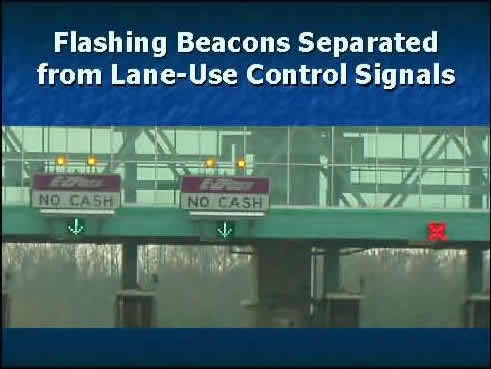
the toll plaza canopy as needed. Flashing beacons should
not be installed together with lane-use signals. Flashing yellow beacons
are effective to draw attention to certain signs and to objects in the roadway,
but when positioned adjacent to lane-use signals, may be confusing. To
highlight a particular lane to approaching traffic, flashing beacons may
be used with an overhead canopy sign but these should be located in a manner
that is distinctly associated only with the sign and separated from the
lane-use signals (see attached example 8).
We believe the best practice recommendations discussed in this policy memorandum
represent a positive first step in promoting uniformity and consistency of
toll plaza design and operation. We welcome your questions and comments
as we continue to identify appropriate strategies for traffic control at
toll plazas. Please
contact Ms. Linda L. Brown of my staff at 202-366-2192 or via e-mail at Linda.L.Brown@dot.gov.
Attachment
Example Diagrams for Toll Sign Colors and Use of Flashing Beacons
Example 1
Example 2
Example 3
Example 4
Example 5
Example 6
Example 7
Example 8